
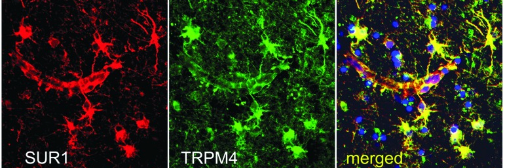
The J Marc Simard, MD, PhD lab investigates molecular mechanisms of cerebral edema formation, blood-brain barrier dysfunction, and neuroinflammation after acute and chronic CNS injury. The lab's efforts led to the discovery of the SUR1-TRPM4 channel, which contributes to secondary injury after stroke, traumatic brain and spinal injury.
The laboratory's efforts led to the discovery of the novel SUR1-TRPM4 channel, which contributes to secondary injury after stroke and traumatic brain and spinal injury.
Multiple clinical trials have directly stemmed from this work, including the ongoing phase III multisite CHARM trial, which investigates the use of the SUR1 inhibitor glyburide to reduce cerebral edema after ischemic stroke.
Dr. Simard continues his focus on moving basic science discoveries from the laboratory to the bedside, with the goal of providing safer and more effective treatments for patients. To advance the ground-breaking research of Dr. Simard, the University of Maryland School of Medicine and the Department of Neurosurgery have endowed the FIRST research laboratory at this institution with the establishment of the J. Marc and Philippe Simard Neurosurgery Endowment Fund.
Visit the Simard Endowed Laboratory for more information.
Key Work
- Chen, M., & Simard, J. M. (2001). Cell swelling and a nonselective cation channel regulated by internal Ca2+ and ATP in native reactive astrocytes from adult rat brain. Journal of Neuroscience, 21(17), 6512-6521.
- Simard, J. M., et al. (2006). Newly expressed SUR1-regulated NC Ca-ATP channel mediates cerebral edema after ischemic stroke. Nature Medicine, 12(4), 433-440.
- Simard, J. M., et al. (2007). Endothelial sulfonylurea receptor 1–regulated NC Ca-ATP channels mediate progressive hemorrhagic necrosis following spinal cord injury. The Journal of Clinical Investigation, 117(8), 2105-2113.
- Gerzanich, V., et al. (2009). De novo expression of Trpm4 initiates secondary hemorrhage in spinal cord injury. Nature Medicine, 15(2), 185.